Beyond the Meeting Room: Women in Kwale Are Learning How to Turn Community Concerns into Policy Change
Beyond the Meeting Room: Women in Kwale Are Learning How to Turn Community Concerns into Policy Change
For many women in Kwale, the challenges affecting their daily lives are easy to identify. They include limited access to finance, unemployment, inadequate childcare support, and barriers that make it difficult for women to grow their businesses and participate fully in decision-making.
But identifying a problem is only the beginning. Knowing which government office is responsible, how public resources are allocated, which laws and policies can be used, and how to engage decision-makers is what can turn a community concern into meaningful change.
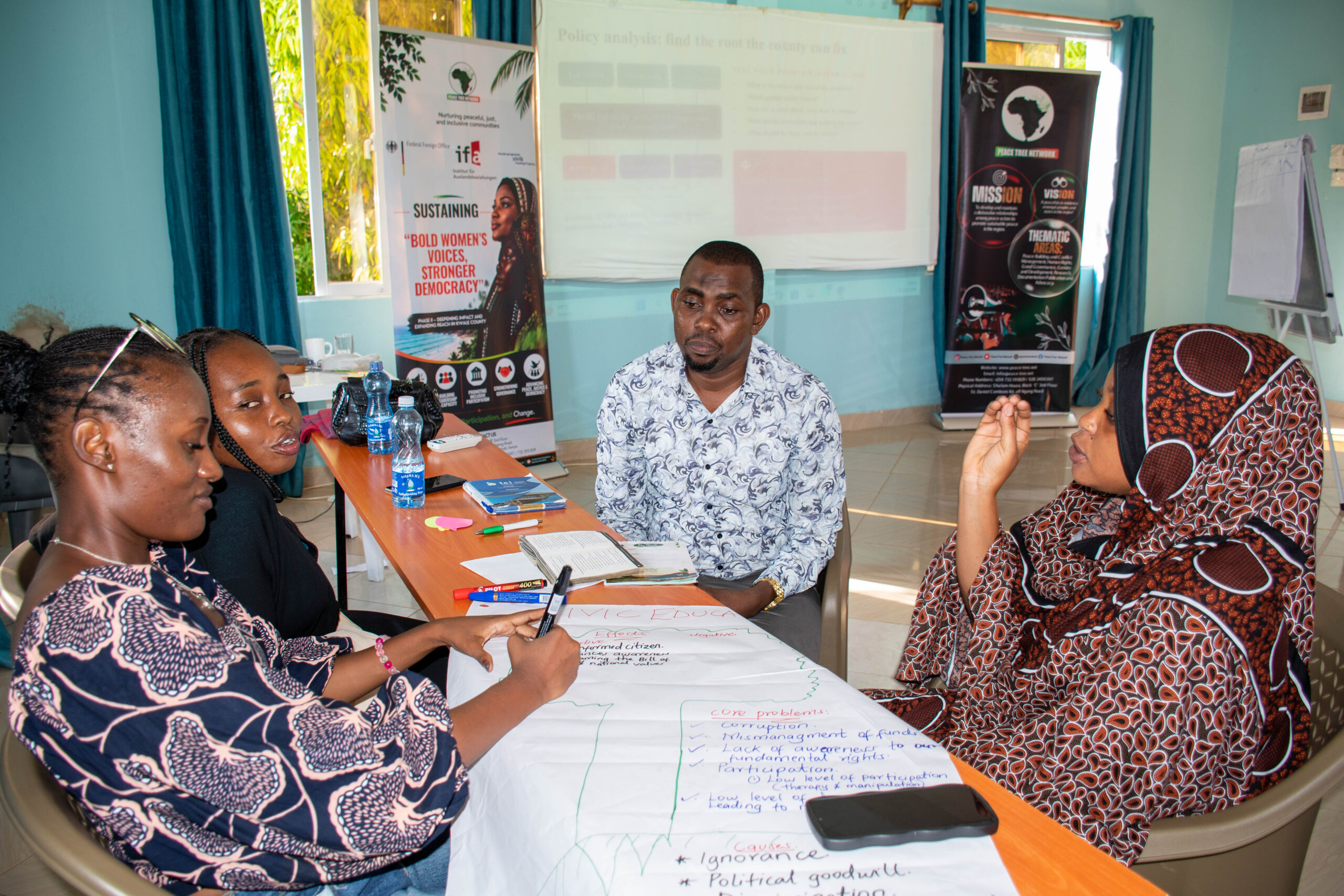
This is the knowledge participants are beginning to acquire through the Advanced Policy Advocacy Training taking place at Grassroots’ Voices CBO in Kinondo Ward, Kwale County.
The training, which began on 16 November 2026, is bringing together community leaders and other local actors to explore how policy decisions are made, how public resources are prioritised, and how citizens can influence the decisions that shape their communities.
When the community is asked to choose
One of the exercises invited participants to imagine that Kwale County had KSh 19 billion to invest in development. They were asked to identify the two priorities they would choose and explain why.
The exercise moved the conversation beyond simply listing community needs. Participants had to consider competing priorities, available resources and the possible impact of different investments.
Discussions touched on education, women’s economic participation, youth employment, bursaries, vocational training and support for small businesses. Participants also considered the importance of partnerships between government and the private sector in creating opportunities for young people.
The exercise demonstrated a central lesson: public resources are limited, and decisions about how they are spent have real consequences for people’s lives.
For women who run small businesses, engage in agriculture, participate in fish-related activities or depend on informal trade, budget decisions can determine whether opportunities for economic growth become accessible or remain out of reach.
Early childhood development is also a policy priority
The discussion also brought in the perspective of Julia Mwihaki, an aspiring Member of the County Assembly (MCA), who raised the importance of Early Childhood Development (ECD).
Her contribution brought attention to an issue that is often discussed as a social concern but must also be understood as a public investment priority. Early childhood development affects children, families and the wider community. Decisions about the services and resources supporting young children therefore matter when communities engage with county planning and budgeting.
For aspiring leaders, understanding these processes is particularly important. It is not enough to identify what communities need; leaders must also understand how to make the case for those needs within the structures responsible for planning, allocating and overseeing public resources.
Understanding the language of budgets
For facilitator Morris Andati, one of the most important lessons is that community priorities must be connected to realistic financial plans.
As he reminded participants:
“If you don’t have a clear budget, then it becomes a dream.”
The statement captured an important distinction explored during the sessions: a good idea does not automatically become a funded programme. Participants examined how policies, laws, regulations and budgets relate to one another, and why understanding these differences matters when advocating for change.
Through practical activities, they explored the roles of duty bearers and rights holders, the relationship between policy commitments and available resources, and how county budget documents can be used to follow public spending decisions.
The learning was not limited to community leaders. Journalist Simiyu also described the training as life-changing, particularly because he is learning about budgeting. For a journalist, this knowledge can strengthen the ability to understand public expenditure, explain budget decisions and help Kwale residents make sense of how public resources are planned and used.
This is an important connection between policy advocacy and public communication: when more people understand budgets, communities are better placed to ask informed questions and engage with decisions that affect them.
From knowing the law to questioning implementation
Participants also examined the difference between having policies and laws in place and seeing them implemented.
Discussions considered public participation, access to information and the importance of knowing which institutions are responsible for particular services and decisions. Participants explored how community members can use existing frameworks to engage government, submit memoranda and follow up on commitments.
The challenge is not simply to attend public participation meetings. It is to understand the process, prepare relevant contributions, use appropriate language and follow through.
As Andati explained during the session:
“You can write a memorandum, but if you do not use the right language, or specific words to be put somewhere, or specific things to be put somewhere, they will throw it out because, yes, the idea around it is very good, but how you have worded it, you have worded it in a wrong way.”
The lesson is that effective advocacy requires more than having a valid concern. It also requires knowing how to communicate that concern in a way that speaks to the relevant policy, legal and budget processes.
Looking beyond immediate needs
The conversations also challenged participants to think about Kwale’s longer-term economic direction. Discussions around agriculture, the cashew value chain, processing and access to markets opened up questions about how county planning can support local livelihoods and create more opportunities for residents.
Participants considered the different economic activities women are already engaged in, including retail, agriculture, fish-related activities, salons, small shops and professional services. They also reflected on the barriers that can prevent these activities from growing, including access to finance and the availability of childcare.
Childcare emerged as an important part of the wider discussion on women’s economic participation. When women lack reliable childcare support, their ability to attend meetings, pursue training, run businesses and take up leadership opportunities can be constrained.
These discussions reinforced the importance of looking at economic empowerment in a broader way: not only as access to loans or business opportunities, but also as the policies, services and systems that allow women to participate and thrive.
Building the confidence to influence decisions
The training is helping participants connect issues they encounter in their communities with the institutions, laws, policies and budgets that shape responses to those issues.
For an aspiring leader like Julia Mwihaki, the discussions around ECD demonstrate why understanding public priorities and resource allocation matters. For journalist Simiyu, learning how budgets work offers practical knowledge that can help him explain public decisions to Kwale residents. And for community leaders, the sessions are building a stronger foundation for asking questions, engaging duty bearers and advocating for priorities that reflect the needs of their communities.
This is what makes the process more than a training exercise. It is about strengthening the ability of local actors to understand how decisions are made and to participate more effectively in shaping them.
As the training continues, the focus remains on translating knowledge into practical advocacy: identifying the right entry points, making evidence-informed arguments, engaging the relevant decision-makers and holding institutions accountable.
Because having a voice is important. Knowing where to take it, what to ask for and how to hold decision-makers accountable is what gives that voice influence.